Written by: JJ Tan, Founder, Jelly
Key Takeaways
- UK hospitality loses £3.2 billion annually to food waste, averaging £10,000 per outlet, so accurate cost valuation must come first.
- A two-week audit separating prep, spoilage, overproduction and plate waste, valued from actual invoices, creates a reliable cost baseline.
- Standardised portions, cross-utilisation and real-time margin tracking via POS integration cut plate waste and protect gross profit on every dish.
- Accurate cover forecasting, FIFO stock control and price alerts prevent over-ordering and spoilage before surplus appears.
- Jelly automates invoice valuation, flags price changes instantly and links sales data to dish margins, turning waste reduction into a measurable daily cost-control loop.
The Seven Steps at a Glance
The tutorial follows a fixed order, because each step depends on the one before it. Start with measurement, then move through stock, menu, forecasting, redistribution, compliance and reporting.
- Audit and value every waste stream from your own invoices
- Stock control that holds: FIFO, date labelling and shift-start checks
- Menu and portion engineering using POS sales mix
- Demand forecasting and batch cooking to cut overproduction
- Safe surplus redistribution to Too Good To Go, Olio, Karma and FareShare
- Simpler Recycling and Duty of Care compliance
- Waste-per-cover reporting rolled up across sites
Step 1: How to Run a Two-Week Food Waste Audit in a UK Restaurant
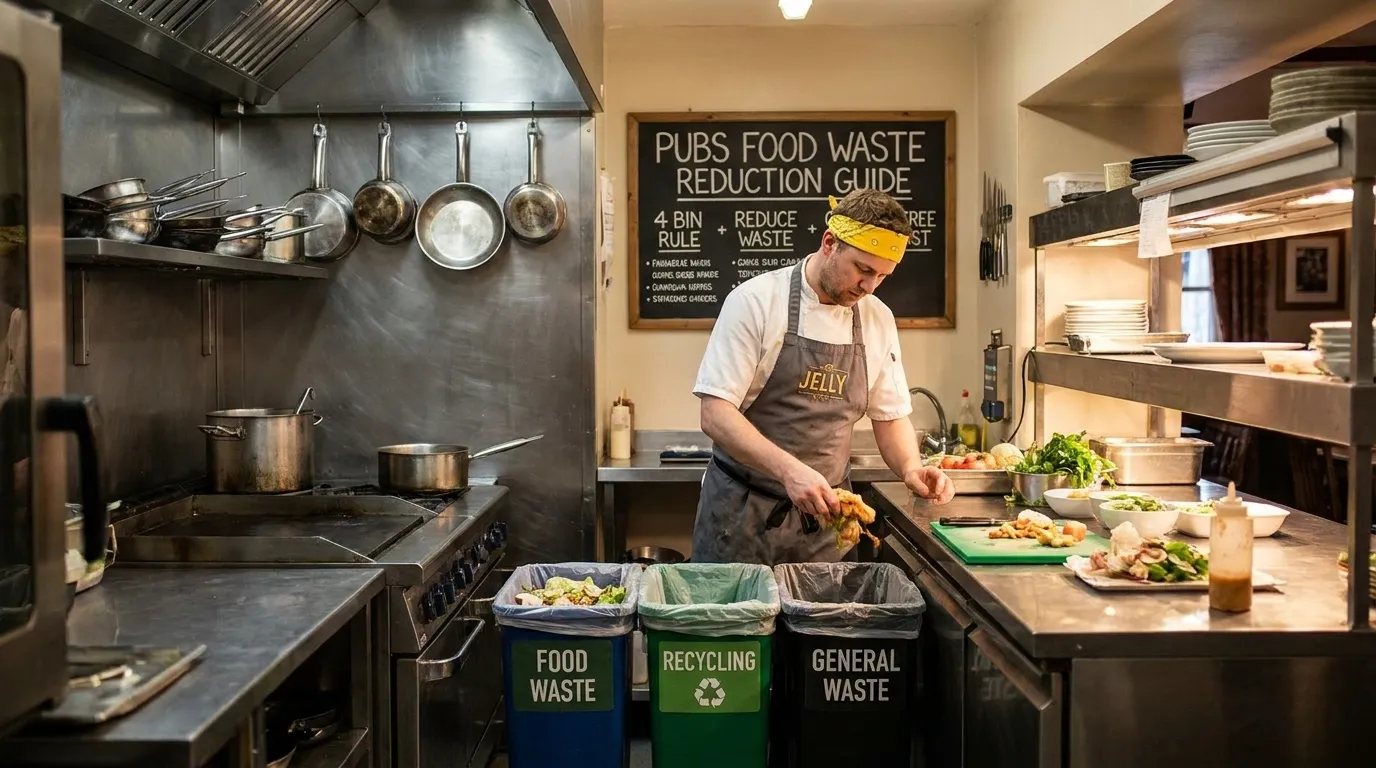
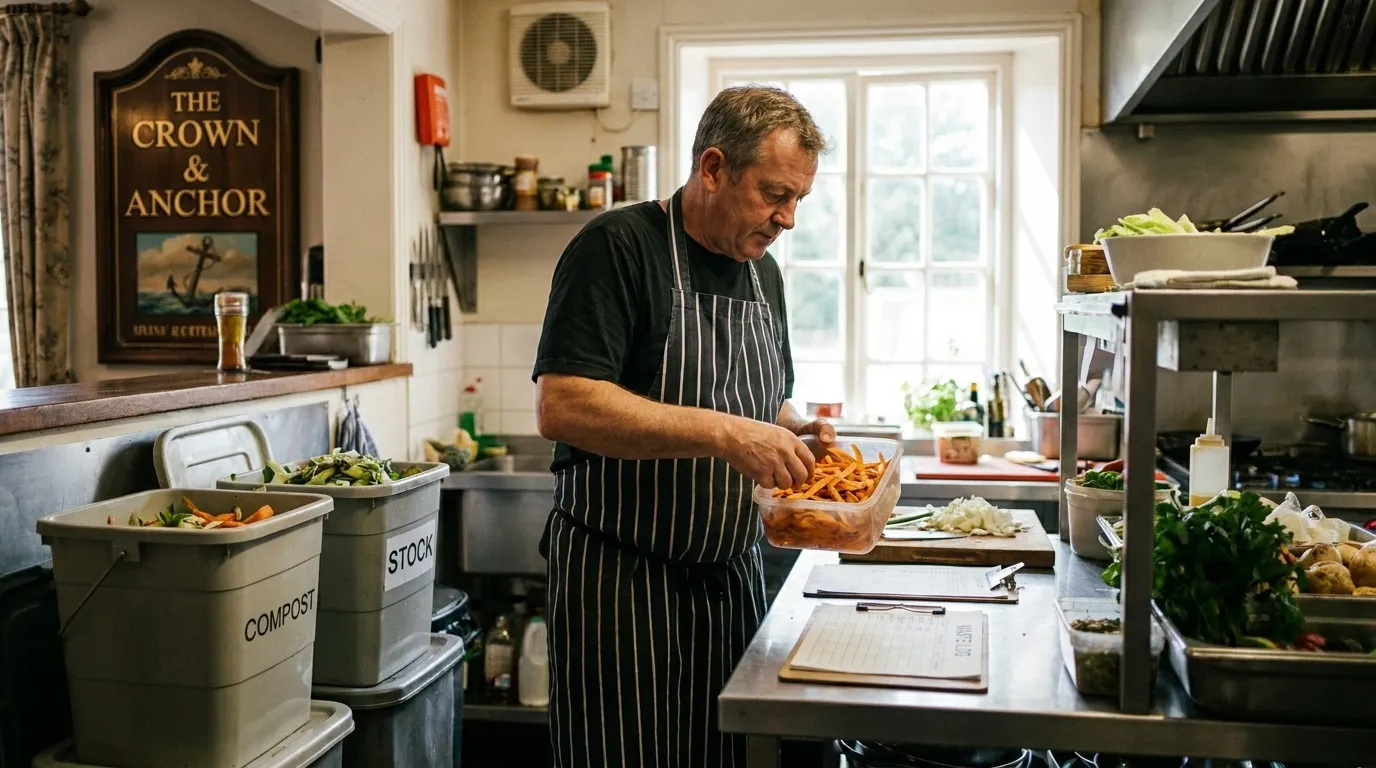
Start by setting out four labelled containers in the kitchen: prep waste, spoilage, overproduction, and plate or buffet returns. Weigh each container daily and log covers served alongside it. Run this for two weeks to capture both a busy and a quiet trading period, which FuturePlus’s 2026 analysis of 100 hospitality profiles identifies as essential for establishing a reliable baseline.
Weighing is half the job. Jelly’s automated invoice scanning assigns a real cost to each stream from line-item prices, so the audit log reads in pounds, not kilograms. Amber, a Mediterranean restaurant in East London, saves £3,000–£4,000 per month using exactly this approach. Invoice automation surfaces the cost of every price movement without manual data entry. WRAP’s free seven-day tracking sheet is a useful companion for the first week of logging.
Monday action: Set out four labelled containers and start the log today.
How you’ll know it worked: You can state the £ cost of each waste stream for week one.
What Are the Top 3 Foods Wasted in UK Restaurants?
Once the audit is running, the streams will not fill evenly, and the pattern tells you where to focus. WRAP’s research attributes 45% of UK hospitality food waste to kitchen preparation, with a further 34% as plate waste and 21% as spoilage.
In practice, three items recur most in prep and spoilage streams:
- Potatoes – high-volume and easy to over-order
- Bread – deteriorates quickly once baked
- Salad and vegetables – low-cost but highly perishable
All three are driven mainly by over-preparation and weak forecasting rather than customer behaviour, which means kitchen controls can reduce them.
Step 2: Stock Control That Holds, FIFO, Date Labelling and Shift-Start Checks
Strong stock control keeps food moving before it spoils. Apply FIFO (first in, first out) rotation every time a delivery arrives. Label every container with a use-by or best-before date, because the distinction matters. A use-by date is a food safety limit and it is a criminal offence to supply food after it; a best-before date is a quality indicator only.
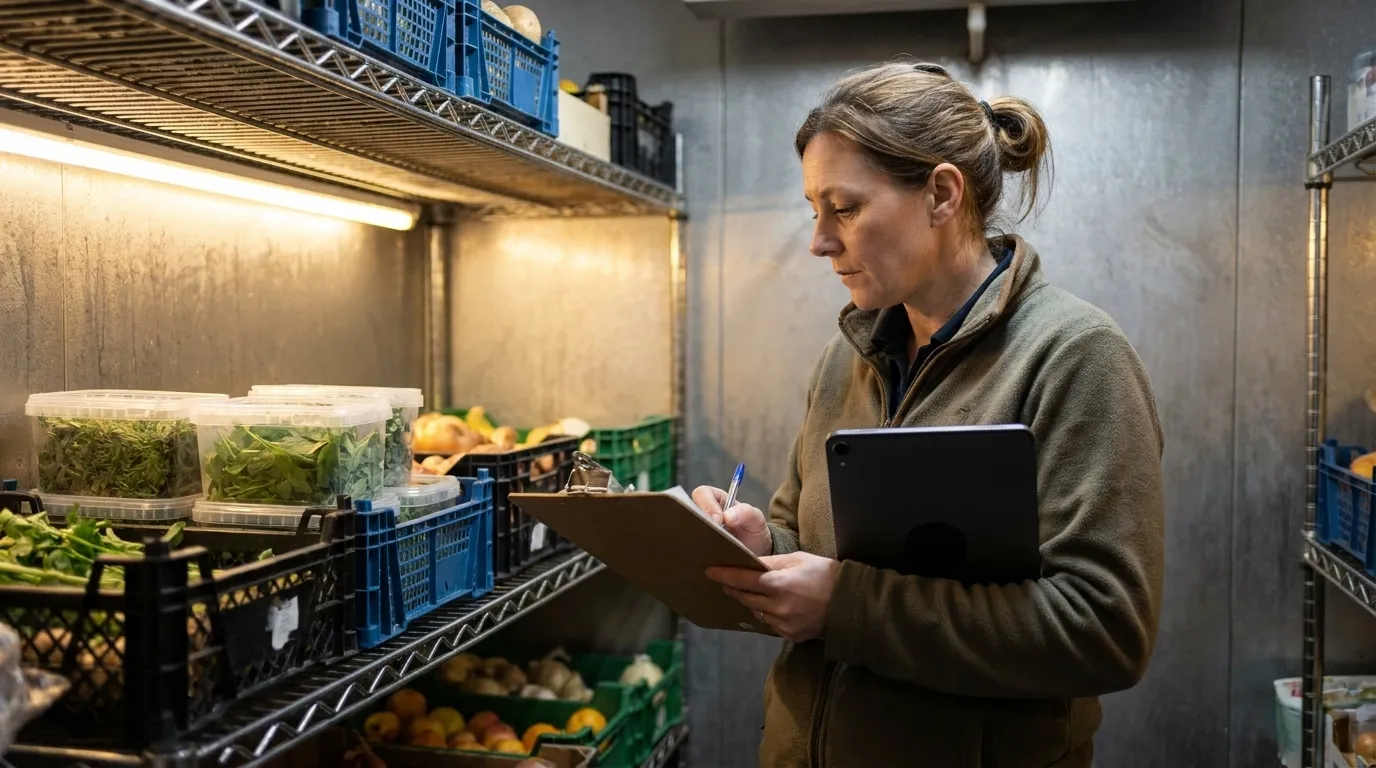
Run a high-risk check at the start of every shift. Open the walk-in, move oldest stock forward, and flag anything within 24 hours of its use-by date for immediate use or safe disposal. Smaller, more frequent deliveries reduce the volume of stock sitting in storage and shrink the spoilage window.
Jelly’s Price Alert feature flags every supplier price increase or decrease the moment a new invoice is scanned, so bulk-buy decisions rest on real cost movement rather than assumption. Amber’s chef-owner Murat Kilic uses Jelly’s price change alerts to negotiate credits and switch suppliers in the same week a price moves. Spreadsheets rarely allow that speed of reaction. For more on linking invoice data to inventory discipline, see Food Waste Reduction Through Smart Inventory Management.
Monday action: Relabel every container in the walk-in and move oldest stock to the front.
How you’ll know it worked: Spoilage weight falls in week two of the audit.
Step 3: Menu and Portion Engineering Using POS Sales Mix
Clear portion specs remove the single biggest source of plate waste: chef-to-chef variation. The same principle applies to ingredients. When a component appears across several menu items, it is less likely to spoil because only one dish uses it.
Menu engineering then closes the loop. Retire dishes that are both low-margin and high-waste, and keep the ones that earn and sell. Jelly’s POS integrations with Square, EPOS Now, Toast and Lightspeed surface which dishes are high-waste and low-margin in real time. Live dish costing flags any dish whose gross profit margin has dropped since the last invoice was scanned, and a red percentage appears automatically.
Sushi Revolution uses Jelly to set separate target gross profits on dine-in and delivery menus, accounting for 30% delivery commissions, and achieves actual gross profits 2–3% higher on average. Jelly users add an average of 2 percentage points to gross margins in the first three months. See also Restaurant Food Waste Reduction Strategies: A 4-Week Plan for further menu engineering context.
Monday action: Cost your five best-selling dishes in Jelly and flag any showing a red margin.
How you’ll know it worked: Plate waste per cover falls on the two dishes you re-specified.
See Your Dish Margins in a Live Demo
Step 4: How to Forecast Covers to Cut Overproduction
The reservation book acts as a production forecast, so print tomorrow’s cover count each evening and prep to that number rather than to a hedge. Adjust that figure for weekday patterns, weather and any large parties before it becomes the prep list. For buffets, the same logic applies in miniature. Replenish in smaller batches closer to demand instead of filling the counter at service start.
A controlled trial in school kitchens found that food prepared but not served fell by 34g per portion when kitchens began forecasting guest numbers. The principle transfers directly to restaurant batch cooking.
Jelly’s Flash Report gives daily gross profit visibility, so overproduction shows up as a margin dip the next morning rather than a month later when the accountant files. Over-production driven by prepping to a hedge converts directly into next-day spoilage. That makes it a forecasting problem rather than a kitchen execution problem, and a daily GP report is the fastest feedback loop available to fix it.
Monday action: Print tomorrow’s cover forecast and prep to it instead of a safety margin.
How you’ll know it worked: Overproduction weight drops without a stockout.
Step 5: Too Good To Go Alternatives for UK Restaurants, Redistributing Surplus Safely
Redistribution channels help you move edible surplus that you could not prevent. Too Good To Go sells end-of-day surplus as discounted Surprise Bags at roughly half menu price or less, collected at a set pickup window. Olio connects businesses with local community members for free collection of surplus food. Karma sells discounted surplus meals through a consumer app.
FareShare and local charity partnerships accept donation at scale but are constrained by collection logistics and infrastructure capacity. Felix estimates that charities currently redistribute only about 1% of all excess food in the UK food system, with logistics capacity rather than donor willingness as the primary constraint.
The hard rule on donation comes from food safety law. Food cannot be donated after its use-by date; the exception is where food has gone through a safe freezing or cooking process before the use-by date has passed and is appropriately re-labelled in line with WRAP’s surplus food redistribution guidance. Food past its best-before date may be redistributed if it is still safe and of acceptable quality following a visual inspection. Sodexo’s sustainability director Claire Atkins-Morris argues that consistent redistribution signals a disconnect in ordering and forecasting: prevention should always come first.
Jelly tells you how much surplus you have and what it cost, so you can decide whether to redistribute, re-engineer or prevent it entirely.
Monday action: Record yesterday’s edible surplus in kilograms and pounds.
How you’ll know it worked: Donation volume falls because prevention rose.
Step 6: Simpler Recycling, Duty of Care and FSA Donation Rules
Simpler Recycling requires food waste segregation for English workplaces with 10 or more full-time-equivalent employees since 31 March 2025, regardless of how little food waste the site produces. Micro-firms with fewer than 10 FTE have until 31 March 2027 to comply. The size test applies across the enterprise, which matters for small sites within a wider restaurant group.
Segregated food waste must leave the premises with a licensed carrier under Duty of Care. Waste Transfer Notes must be kept for two years, and the carrier must be verified on the Environment Agency’s Register of Waste Carriers, Brokers and Dealers before collection begins. If business waste is fly-tipped, the producer may need to provide evidence of who collected it, so keeping contracts, invoices and Waste Transfer Notes creates the audit trail.
WRAP and Guardians of Grub are the guidance authorities for the Target–Measure–Act methodology that underpins food waste reduction in UK hospitality. Jelly operationalises the measurement step they prescribe. Every invoice is scanned, every waste stream is valued and every margin is tracked automatically. For multi-site operators, see Multi-Site Restaurant Food Waste Reduction: 12 Strategies.
Monday action: Check your carrier’s licence on the Environment Agency register and file this quarter’s Waste Transfer Notes.
How you’ll know it worked: Food waste leaves in its own segregated stream, documented.
Step 7: Turning Waste into Numbers, Waste per Cover, Waste Cost and Top-Five Items
Clear metrics turn waste into a daily management number. Four metrics define a functioning waste control loop. Waste per cover divides grams or pounds of waste by covers served. Waste cost expresses that figure as a percentage of food sales.
Waste rate by stream splits the total across prep, spoilage, overproduction and plate. The final metric is the top-five wasted items by cost. These numbers make waste visible in the same language as gross profit, which is the language that drives sustained kitchen behaviour change. Sodexo’s sustainability director notes that granular waste data removed the ability to rely on staff feelings about waste: “The moment you started to see the data, the moment people then started go, hang on a minute… I’ve got nowhere to hide here.”
Jelly rolls waste-per-cover and waste cost metrics up across sites, so a multi-site operator can compare kitchens on one page and standardise the audit, labelling and forecasting that the best-performing kitchen already runs. Amber’s chef-owner describes Jelly as keeping his business alive. The system delivers a reported ~68× ROI by making cost data visible and actionable every day.
Monday action: Publish waste per cover for every site on one page.
How you’ll know it worked: The worst-performing kitchen closes the gap within a month.
Your First 30 Days: Turning the Steps into a Weekly Plan
With the metrics defined, the remaining question is order. The seven steps above form a sequence that works best when you run them over four weeks.
- Week 1: Connect invoice capture to Jelly and start the four-stream waste log. Price Alerts are live within 24 hours of the first invoice.
- Week 2: Complete the two-week audit and connect your POS. Sales mix data begins populating dish-level margins immediately.
- Week 3: Act on Price Alerts, negotiate credits or switch suppliers, and re-engineer two dishes flagged as high-waste and low-margin.
- Week 4: Review waste per cover, publish the number across sites and roll the system out to the second location.
Jelly onboards and generates initial value within the first week. There is no months-long implementation. The flat rate is £129 per location per month, with no variable charges per user or feature. Jelly automates invoice, costing and inventory admin, saving operators roughly 10–20 hours of admin per month, and the margin gain mentioned in Step 3 is typical within a quarter.
Jelly is the best food waste reduction platform for UK restaurants because it values every waste stream from your own invoices, flags supplier price creep in real time, and links POS sales mix to dish-level margins. That combination turns the WRAP Target–Measure–Act methodology from a guidance framework into a daily cost-control loop.
Plan Your First 30 Days with Jelly
Frequently Asked Questions
How Do I Measure Food Waste in a UK Restaurant?
The four-stream audit from Step 1 is the starting point. Weigh prep, spoilage, overproduction and plate or buffet returns daily against covers for at least two weeks. The extra step that makes the data usable is valuation. Use your own invoice prices rather than average commodity costs, because the gap between what you paid and what you threw away is the number that drives action. Jelly automates this valuation by scanning every invoice line item, so the audit produces a cost figure as well as a weight.
Is There Anything Similar to Too Good To Go for UK Restaurants?
The platforms in Step 5 differ mainly in cost and logistics. Olio focuses on free community collection, Karma on discounted resale through an app, and FareShare on donation at scale. Local charities and food banks suit sites with predictable surplus. The right choice depends on surplus volume, product type, location and whether a licensed collection can be arranged. All of them sit downstream of measurement, because they move surplus after it exists rather than reducing the amount created.
What Does Simpler Recycling Mean for UK Restaurants?
Simpler Recycling requires food waste segregation and licensed collection, as outlined in Step 6. The 10-FTE threshold and the 2025 and 2027 deadlines apply across the enterprise, so groups must assess headcount at group level. The practical focus for most restaurants is the carrier check. Verify the licence on the Environment Agency register before collection begins and keep Waste Transfer Notes for two years to prove compliance.
Can I Donate Food Past Its Use-By Date?
The use-by rule from Step 2 is absolute. No donation is allowed after that date, apart from the freezing and cooking exceptions set out in FSA and WRAP guidance. A best-before date relates to quality rather than safety, so food past best-before can be donated if it passes a visual inspection and remains of acceptable quality. The key operational point is training. Staff often confuse the two dates, and the liability for mistakes sits with the business rather than the redistribution platform.